


The evolution of outdoor entertaining has elevated garden spaces from seasonal afterthoughts into architectural extensions of the home. At the heart of this transformation sits the built in BBQ grill, a permanent fixture that anchors sophisticated outdoor kitchens and redefines al fresco dining. Unlike portable units that compromise on performance and aesthetics, built in bbq grills deliver restaurant-calibre cooking whilst seamlessly integrating into bespoke cabinetry, creating cohesive outdoor living environments that function beautifully throughout the year.
Built in bbq grills represent a fundamental shift in outdoor cooking philosophy. These permanently installed appliances integrate directly into custom countertops and cabinetry, offering superior heat retention, expanded cooking surfaces, and professional-grade components that portable alternatives cannot match.
The architectural permanence of these installations allows for proper ventilation planning, utility connections, and weatherproofing considerations from the outset. When you commit to a built-in configuration, you're investing in a cooking solution designed to withstand British weather patterns whilst maintaining peak performance across seasons.
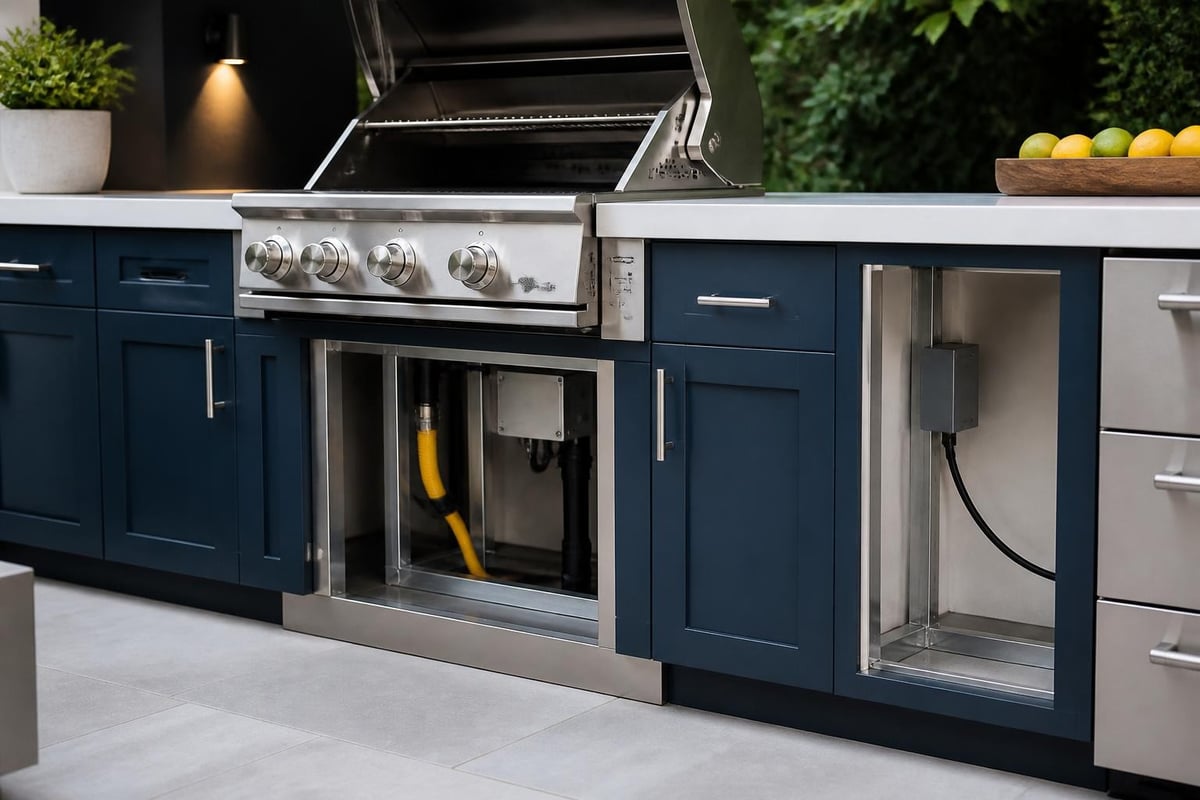
The performance advantages stem from engineering rather than marketing. Built in bbq grills typically feature:
This specification leap translates to tangible cooking improvements. Searing temperatures reach 700°F within minutes, whilst low-and-slow configurations maintain stable 225°F zones for hours. The thermal mass of built-in units buffers against wind and ambient temperature fluctuations, critical considerations in exposed British garden settings.
According to planning guidelines from the National Kitchen & Bath Association, properly specified built-in grills should include minimum 36-inch counter landing areas on either side, facilitating the workflow patterns essential to serious outdoor cooking.
Beyond performance metrics, built in bbq grills enable architectural coherence impossible with freestanding equipment. Custom installations align fascia finishes, control placement, and sight lines with surrounding cabinetry, creating unified outdoor environments.
Material continuity matters profoundly. When grill heads coordinate with stainless steel drawers, granite worktops, and powder-coated frames, the result reads as intentional architecture rather than assembled products. Architectural Digest's coverage of outdoor kitchen trends consistently highlights this integrated approach as defining luxury outdoor spaces in 2026.
Selecting appropriate built in bbq grills demands methodical evaluation across multiple technical dimensions. The specifications that matter extend well beyond burner counts and overall width.
The foundational decision centres on fuel source, each presenting distinct advantages and installation implications:
| Fuel Type | Infrastructure Need | Heat Output | Flavour Profile | Running Cost (2026) |
|---|---|---|---|---|
| Natural Gas | Mains connection & certified installation | Consistent, adjustable | Clean, neutral | £0.08-0.12/kWh |
| LPG (Propane) | Storage tank & regulator | High heat capability | Clean, neutral | £0.15-0.22/kWh |
| Charcoal Insert | Ventilation & ash management | Variable, intense | Rich, smoky | £0.30-0.45/kg |
| Hybrid Systems | Multiple connections | Maximum flexibility | User-controlled | Variable |
Natural gas connections require professional installation complying with current building regulations, whilst LPG systems offer flexibility for properties without mains access. The NFPA provides comprehensive guidance on clearance requirements and safety protocols for gas-fired built-in grills, essential reading before specification.
Premium built in bbq grills deploy multiple burner types to create distinct cooking zones within a single platform:
The strategic arrangement of these elements determines functional versatility. A well-configured 36-inch built-in might include four primary burners, one infrared sear zone, and a rear rotisserie burner, enabling simultaneous high-heat searing, moderate grilling, and slow roasting.
Construction materials directly influence both performance and service life. Built in bbq grills destined for British gardens must withstand persistent moisture, temperature cycling, and coastal salt exposure in certain regions.
Stainless steel grades matter considerably. Type 304 stainless offers adequate corrosion resistance for most UK environments, whilst Type 316 marine-grade stainless provides superior protection in coastal locations. Cast stainless steel grates retain heat more effectively than stamped alternatives, whilst ceramic-coated cast iron offers comparable performance with easier maintenance.
Internal components warrant equal scrutiny. Brass valves outlast zinc alternatives, whilst piezo ignition systems prove more reliable than battery-powered units in damp conditions. The best built in bbq grills employ welded construction rather than fasteners in critical heat zones, eliminating thermal expansion failures over time.
Successful built in BBQ grill installations begin months before equipment arrives, rooted in comprehensive site planning and utility coordination.
The physical environment dictates numerous installation parameters. Prevailing wind patterns influence grill orientation and ventilation requirements, whilst proximity to the main house affects utility routing costs and entertaining flow.
This Old House provides detailed guidance on site preparation, emphasising proper foundation work and drainage planning. Built in bbq grills demand stable, level surfaces, typically requiring reinforced concrete pads or engineered paving systems capable of supporting 400-600 pounds including cabinetry.
Clearance requirements extend beyond the grill footprint. Most manufacturers specify minimum 24-inch lateral clearances from combustible surfaces, whilst overhead clearances range from 36-48 inches depending on BTU output and ventilation configuration.
Professional installations coordinate multiple utility systems:
Gas line sizing calculations account for distance from metre to appliance, total BTU demand, and supply pressure. Undersized lines create pressure drops that compromise burner performance and safety. These systems require certification by Gas Safe registered engineers, with installations documented for building control compliance.
For covered outdoor kitchens incorporating built in bbq grills, ASHRAE technical guidance on ventilation becomes critical. Proper exhaust hood sizing and makeup air provisions prevent smoke accumulation whilst maintaining comfortable entertaining environments.
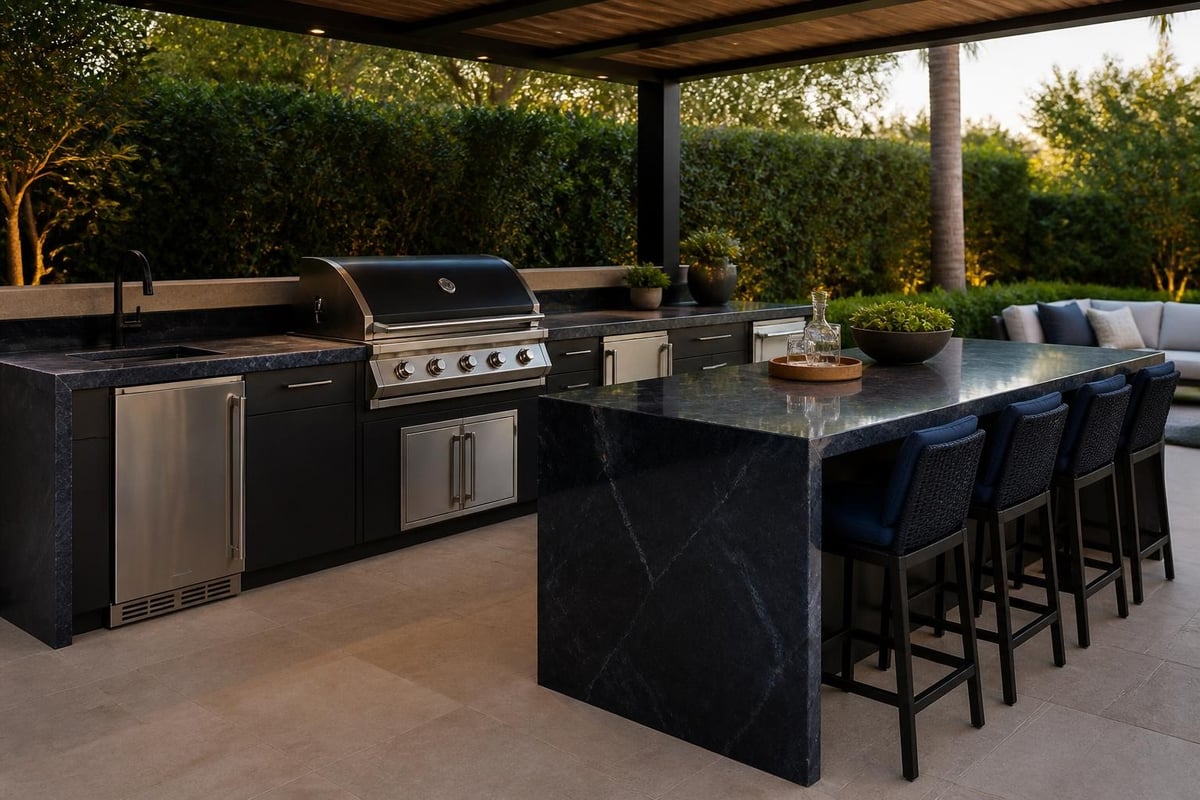
Built in bbq grills integrate into two primary cabinetry approaches, each offering distinct advantages for different project types and budgets.
Modular outdoor kitchen systems provide pre-engineered cabinet units in standard widths, manufactured from weather-resistant materials with factory-finished surfaces. These systems accelerate installation timelines and ensure dimensional compatibility with major grill brands. The Grillandia outdoor kitchen collection, for instance, offers fully customisable modules in various sizes, colours, and configurations, all constructed from UV-resistant, weatherproof materials that withstand long-term outdoor exposure.
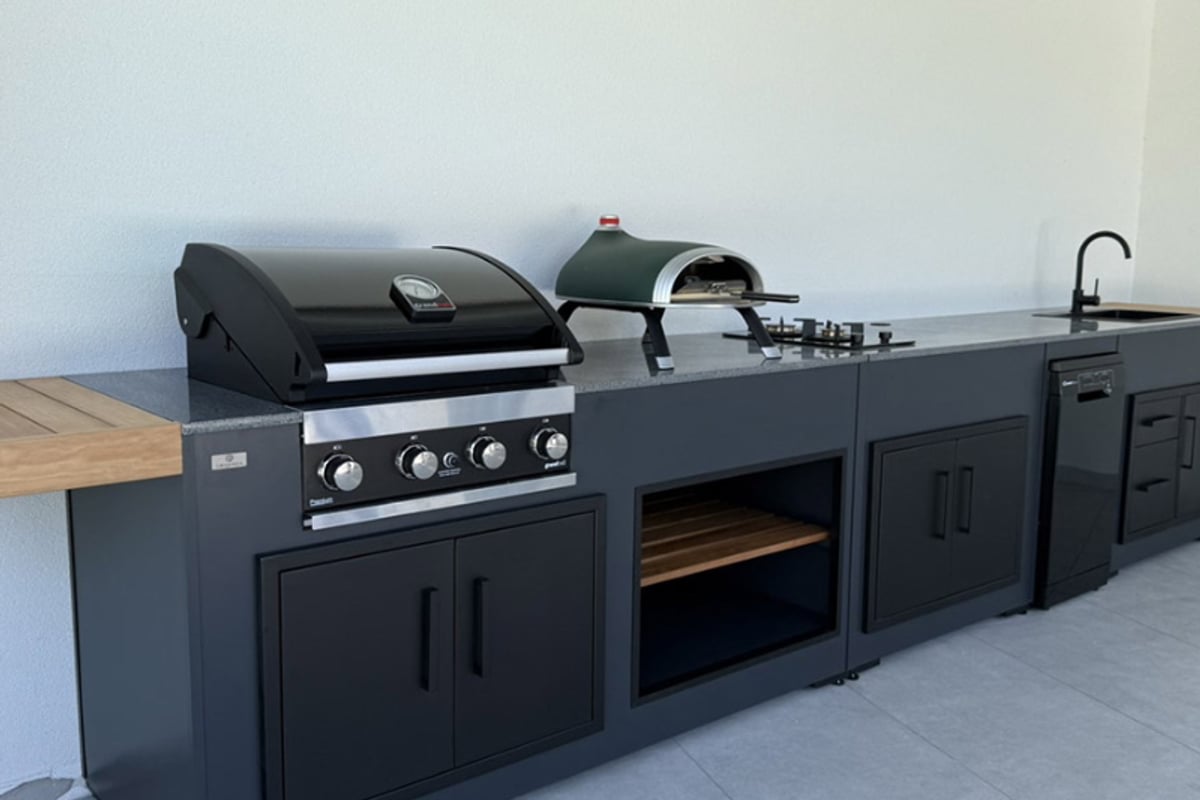
Custom-built solutions, conversely, accommodate unique spatial constraints and architectural requirements. Brick, stone, or poured concrete construction creates permanent structures that match home exteriors whilst allowing complete freedom in layout and dimension. These bespoke installations often incorporate built in bbq grills alongside pizza ovens, smokers, and specialty equipment, creating comprehensive outdoor cooking platforms.
Contemporary built in bbq grills incorporate technological sophistication that would have seemed implausible a decade ago, transforming outdoor cooking from intuitive craft into precision culinary science.
Digital temperature control systems now appear across premium built in BBQ grill ranges. Multi-probe thermometers monitor grate surface temperatures and internal protein temperatures simultaneously, with data transmitted to smartphone applications for remote monitoring.
These systems prove particularly valuable for extended cooking sessions. Low-and-slow barbecue techniques demand stable 225-250°F temperatures for 8-12 hours, previously requiring constant attention and manual adjustment. Integrated controllers maintain target temperatures automatically, adjusting burner output in response to ambient conditions and fuel consumption.
Infrared burner technology represents perhaps the most significant performance advancement in built in bbq grills over recent years. Unlike conventional burners that heat air which then heats food, infrared systems emit radiant energy directly to cooking surfaces.
The practical advantages manifest immediately:
Side-by-side infrared sear stations, now standard on many premium built in bbq grills, enable restaurant-quality crust development on steaks whilst maintaining separate zones for moderate-temperature cooking.
Outdoor kitchens function increasingly as evening entertaining venues, driving demand for integrated lighting solutions. LED illumination systems specifically designed for built in BBQ grills provide task lighting across cooking surfaces whilst withstanding heat and weather exposure.
The convergence of outdoor living and home automation extends beyond cooking appliances. Comprehensive outdoor entertainment systems, such as those designed by specialists like ANR Media, create atmospheric environments with distributed audio, weather-resistant displays, and integrated control systems that coordinate lighting, sound, and climate control throughout garden spaces.
The service life of built in bbq grills correlates directly with maintenance diligence. Whilst quality construction provides durability, consistent care protocols determine whether equipment performs optimally for 10 years or 25.
Effective maintenance begins immediately after each cooking session:
Monthly deep cleaning extends beyond surface maintenance. Remove cooking grates, flavouriser bars, and burner covers to access the firebox interior. Vacuum debris from burner ports and venturi tubes, as blockages compromise combustion efficiency and create safety hazards.
British weather patterns demand seasonal adjustment to built in BBQ grill care routines. Autumn preparation includes:
Contrary to common practice, complete weatherproof enclosure risks moisture condensation and accelerated corrosion. Premium grill covers incorporate vents that allow air circulation whilst shedding precipitation, maintaining dry internal environments throughout winter months.
Spring recommissioning reverses this process, with particular attention to gas connections, igniter function, and burner flame patterns before the first cooking session.
Even premium built in bbq grills require periodic component replacement. Typical service intervals include:
| Component | Expected Lifespan | Replacement Indicators |
|---|---|---|
| Cooking grates | 5-7 years | Warping, excessive rust, coating degradation |
| Burner tubes | 7-10 years | Uneven flame patterns, rust perforation |
| Igniter systems | 3-5 years | Inconsistent sparking, corrosion |
| Flavouriser bars | 3-5 years | Severe corrosion, cracking |
| Rotisserie motors | 8-12 years | Grinding noise, inconsistent rotation |
Proactive replacement maintains performance standards and prevents cascade failures where one degraded component damages adjacent systems.
The outdoor cooking landscape encompasses diverse technologies, each offering particular advantages for specific culinary applications and entertaining styles.
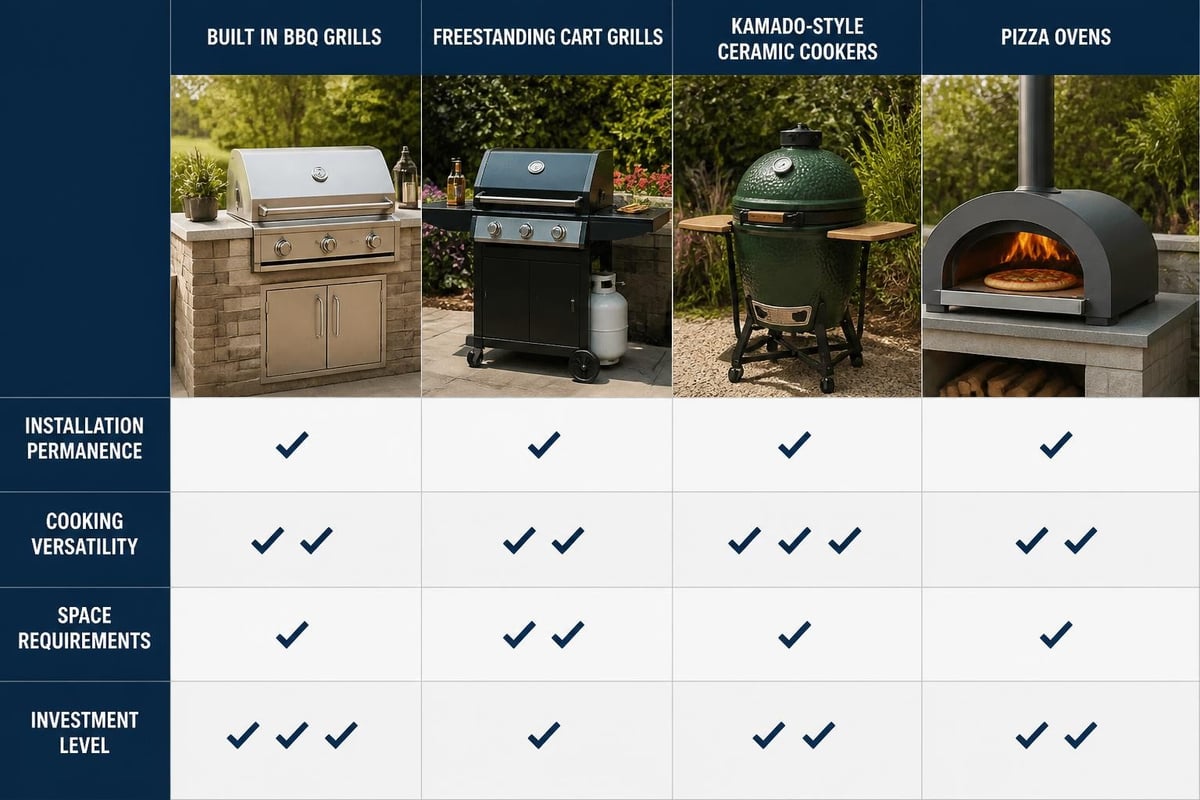
The fundamental distinction centres on permanence and integration. Freestanding grills on carts offer portability and lower initial investment, typically ranging from £500-£2,500 for quality units. They suit renters, those uncertain about long-term garden plans, or anyone requiring seasonal storage.
Built in bbq grills, conversely, demand £2,000-£15,000+ for equipment alone, plus installation and cabinetry costs. This investment buys superior construction, expanded capabilities, and architectural integration that transforms garden spaces. Comprehensive reviews from Bob Vila examine this value proposition across various price points and feature sets.
Sophisticated outdoor kitchens increasingly deploy multiple cooking technologies rather than relying solely on built in BBQ grills:
Pizza ovens deliver authentic Neapolitan results impossible on conventional grills, reaching 900°F+ temperatures that cook pizzas in 90 seconds. The Alfa Forni Moderno Hybrid Pizza Oven exemplifies this category, handcrafted in Italy with both gas and wood-firing capability for maximum versatility.
Kamado-style ceramic cookers excel at low-and-slow smoking whilst providing exceptional fuel efficiency and heat retention. Their thermal mass maintains stable temperatures for extended periods, complementing the quick-searing capabilities of built in bbq grills.
Flat-top griddles expand breakfast and lunch possibilities, accommodating pancakes, smash burgers, and stir-fries that challenge conventional grill grates.
Strategic equipment combinations address broader culinary aspirations than any single platform achieves independently.
The environmental footprint of outdoor cooking merits increasing attention as climate awareness influences purchasing decisions across all consumer categories.
Different fuel types carry distinct environmental profiles. Natural gas combustion produces approximately 50% less CO₂ per BTU than charcoal, with minimal particulate emissions. LPG performs similarly, offering clean combustion with negligible air quality impact.
Charcoal presents more complex environmental accounting. Whilst renewable if sourced from sustainably managed forests, charcoal combustion releases significantly more particulate matter and volatile organic compounds than gas alternatives. The EPA's technical documentation quantifies these emission factors, providing data for informed fuel selection.
Hybrid built in bbq grills address this dichotomy, allowing gas operation for routine cooking whilst preserving charcoal capability for occasions when smoke flavour enhancement justifies higher emissions.
Built in bbq grills demonstrate superior energy efficiency compared to freestanding alternatives, largely through improved insulation and wind protection. Recessed installations within masonry or insulated cabinetry reduce heat loss, whilst integrated designs minimise exposure to wind that strips thermal energy from cooking surfaces.
Covered outdoor kitchens amplify these advantages. When built in BBQ grills operate beneath pergolas or pavilion structures, fuel consumption drops 20-30% compared to fully exposed installations, as radiant heat retention improves and wind interference virtually disappears.
Comprehensive outdoor kitchen projects incorporating built in bbq grills represent significant capital investments, warranting careful financial planning and value analysis.
Equipment purchase prices constitute only one element of total project costs:
Realistic budgets for functional outdoor kitchens centred on quality built in BBQ grills begin around £10,000-£12,000, with luxury installations easily exceeding £40,000-£60,000 when incorporating premium materials, comprehensive equipment suites, and architectural coverings.
Outdoor living spaces deliver measurable property value enhancement, though precise returns vary by location and installation quality. Estate agents consistently report that well-executed outdoor kitchens with built in bbq grills appeal strongly to buyers in premium property segments, particularly within markets like the Cotswolds where outdoor entertaining aligns with lifestyle aspirations.
Beyond resale considerations, the personal value equation centres on usage frequency and lifestyle enhancement. Families who entertain regularly and embrace outdoor living throughout extended seasons derive substantially greater value than occasional users. This calculation increasingly favours built in installations as British summers become warmer and outdoor season duration extends.
Contemporary outdoor kitchen design evolves continuously, influenced by architectural movements, material innovations, and changing entertainment patterns.
The aesthetic landscape has shifted markedly from the ubiquitous stainless steel and granite combinations that dominated the previous decade. Current installations embrace:
Textured stone and concrete: Rough-hewn bluestone, honed limestone, and architectural concrete create organic, grounded aesthetics that harmonise with garden landscapes rather than importing indoor kitchen vocabulary outdoors.
Mixed metal finishes: Black stainless steel, bronze-toned powder coating, and copper accents provide visual warmth whilst maintaining durability standards. Built in bbq grills increasingly offer non-reflective black stainless options that reduce glare and integrate subtly into darker cabinetry schemes.
Natural timber elements: Weather-resistant hardwoods like teak and iroko introduce warmth to predominantly masonry installations, particularly effective for bar fronts, shelving details, and pergola structures.
Linear galley configurations that dominated early outdoor kitchen design increasingly yield to L-shaped and U-shaped layouts that create defined rooms within garden spaces. These configurations position built in BBQ grills as focal points whilst surrounding them with prep surfaces, refrigeration, and storage that support comprehensive cooking workflows.
The concept of outdoor rooms continues gaining traction, with cooking zones forming one element within larger entertaining environments that include dining areas, lounging spaces, and transition zones connecting to main houses. This holistic approach positions built in BBQ grills as anchors within architectural compositions rather than standalone equipment installations.
Built in BBQ grills represent far more than cooking appliances; they serve as foundations for outdoor living environments that extend home functionality into garden settings throughout the year. From initial specification through installation and long-term maintenance, success depends on understanding technical requirements, material performance, and integration principles that unite equipment with architecture.
Whether you're envisioning a compact courtyard cooking station or a comprehensive outdoor culinary destination, Cotswold Cooking Company delivers the consultative expertise, curated product selection, and installation coordination required to transform outdoor spaces into refined entertaining environments that perform beautifully across seasons and reflect your unique entertaining style.

Leave a comment