


A louvre roof pergola represents the pinnacle of architectural outdoor living design, combining intelligent climate control with refined aesthetics to create year-round alfresco entertaining spaces. For homeowners investing in luxury outdoor kitchens, a louvre roof pergola delivers unmatched versatility, allowing precise control over sunlight, ventilation, and weather protection at the touch of a button. This integration transforms seasonal garden features into sophisticated culinary destinations that rival indoor kitchens in functionality whilst celebrating the connection to nature.
The technology behind adjustable louvre systems has evolved dramatically over the past decade. Where traditional pergolas offered static shade or rudimentary fabric canopies, modern louvre roof pergola installations feature motorised aluminium blades engineered to rotate between fully open, partially angled, and completely sealed positions. This precision control enables homeowners to optimise their outdoor environment throughout the day and across all four seasons.
A louvre roof pergola differs fundamentally from conventional pergola designs through its mechanically adjustable blade system. Rather than fixed rafters or static canopies, the roof comprises parallel aluminium blades-typically 100-300mm wide-mounted on a track-and-pivot mechanism that allows rotation from horizontal (open) to vertical (closed) positions.
Premium systems distinguish themselves through several engineering characteristics. Blade thickness typically ranges from 1.2-2.0mm extruded aluminium with powder-coated finishes resistant to UV degradation and coastal corrosion. Motor assemblies feature IP65-rated weatherproofing as standard, with higher-specification installations achieving IP67 protection for complete submersion resistance during extreme weather events.
The most successful louvre roof pergola installations demonstrate architectural coherence with existing property styles. For Cotswold stone properties, powder-coating finishes in heritage colours-soft greys, sage greens, muted bronzes-create sympathetic transitions between traditional architecture and contemporary outdoor living structures.
Structural design requires careful consideration of load paths and foundation requirements. A typical 4m × 4m louvre roof pergola exerts approximately 2-3 tonnes of vertical load when fully closed under water accumulation, with lateral wind loads potentially exceeding 1.5kN/m² in exposed locations. Proper foundation specification ensures long-term stability whilst respecting underground services and established landscaping.
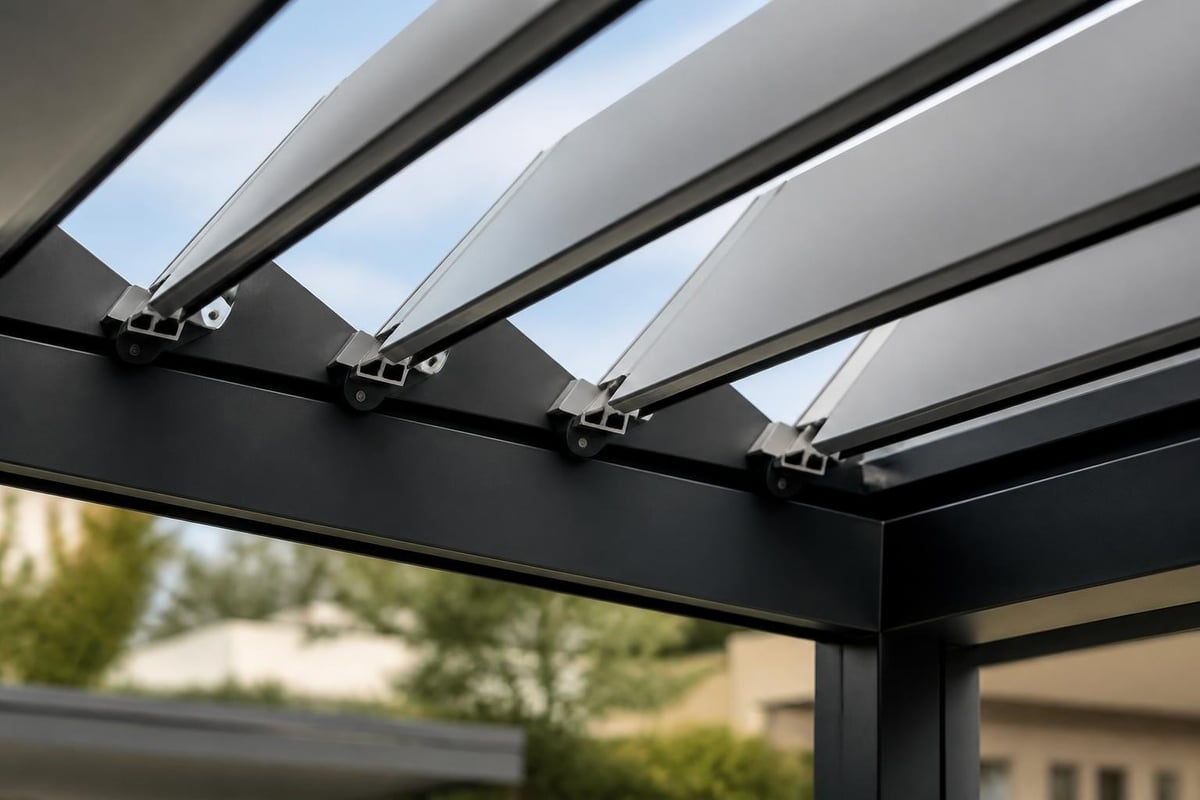
Effective louvre roof pergola design centres on multi-variable climate optimisation. Research from academic institutions studying hybrid louvre systems demonstrates how blade angle, spacing, and orientation interact to balance solar gain, natural ventilation, and precipitation exclusion.
Key performance metrics include:
Modern louvre roof pergola installations feature sophisticated control integration options. Entry-level systems provide hardwired wall switches with open/close/stop functions. Mid-tier specifications add wireless remote controls and timer programming for automated sun tracking throughout the day.
Premium installations integrate with whole-home automation platforms via protocols including KNX, Z-Wave, or proprietary smartphone applications. These systems incorporate weather sensors monitoring wind speed, rain detection, and solar intensity to automatically adjust blade angles-closing during sudden storms or rotating to follow optimal sun angles throughout the afternoon.
| Control Feature | Entry System | Mid-Range | Premium Integration |
|---|---|---|---|
| Hardwired switch | Standard | Standard | Standard |
| Wireless remote | - | Included | Included |
| Rain sensor auto-close | - | Optional | Standard |
| Wind sensor protection | - | Optional | Standard |
| Home automation integration | - | - | Full integration |
| Smartphone control | - | Basic | Advanced scheduling |
Aluminium dominates premium louvre roof pergola construction due to its exceptional strength-to-weight ratio and corrosion resistance. Marine-grade 6063-T6 aluminium alloy, commonly specified for coastal or high-humidity installations, delivers tensile strength exceeding 205 MPa whilst maintaining workability for complex extrusion profiles.
Powder coating represents the standard finishing method, with polyester-based formulations offering 10-15 year warranties against chalking, fading, and delamination. Recent advances in fluoropolymer coatings extend this protection to 20-25 years, particularly valuable for darker colours that traditionally exhibited accelerated UV degradation.
Properties within 5 kilometres of coastline face accelerated corrosion from salt-laden air. Studies examining aluminium performance in coastal cementitious environments highlight the importance of proper material specification and galvanic isolation when integrating louvre structures with mixed-material outdoor kitchens.
Critical detailing considerations include:
The louvre roof pergola achieves its greatest value when thoughtfully integrated with comprehensive outdoor kitchen planning. A well-designed outdoor kitchen unit beneath a louvre canopy transforms from a seasonal amenity into a year-round entertaining destination rivalling indoor facilities.
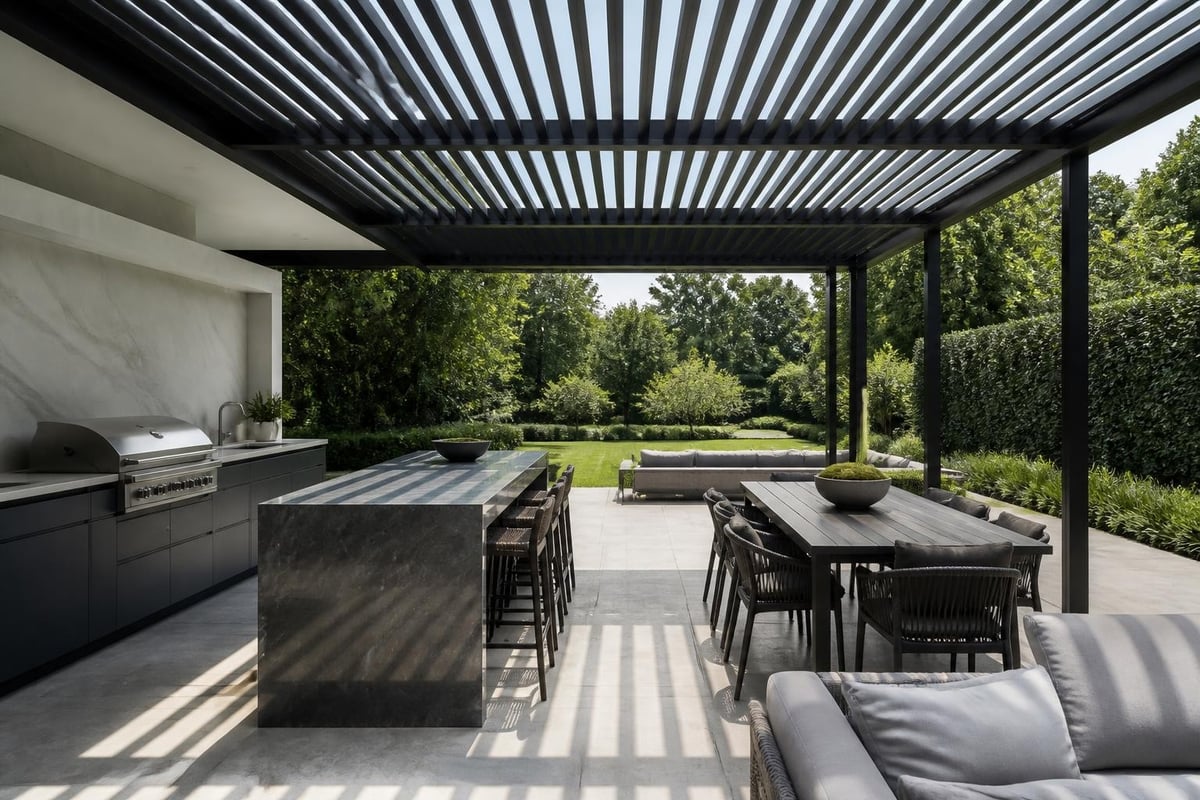
Spatial planning considerations revolve around coverage zones and functional segregation. Premium installations typically provide full coverage over primary cooking equipment-grills, pizza ovens, preparation surfaces-whilst allowing partial coverage or uncovered zones for dining areas that benefit from adjustable sun exposure.
Cooking equipment generates substantial heat and combustion byproducts requiring careful ventilation design. A louvre roof pergola positioned 2.8-3.2 metres above cooking surfaces provides adequate clearance for heat dissipation whilst maintaining headroom comfort. Blade positioning at 30-45° angles during cooking operations creates natural convection pathways that exhaust smoke and steam without requiring mechanical extraction.
For homeowners considering premium appliances, integrating a louvre roof pergola creates an ideal environment for equipment such as wood-fired pizza ovens that benefit from weather protection whilst requiring adequate ventilation. When paired with modular outdoor kitchen systems, the louvre canopy defines distinct functional zones whilst maintaining visual connection to surrounding landscape.
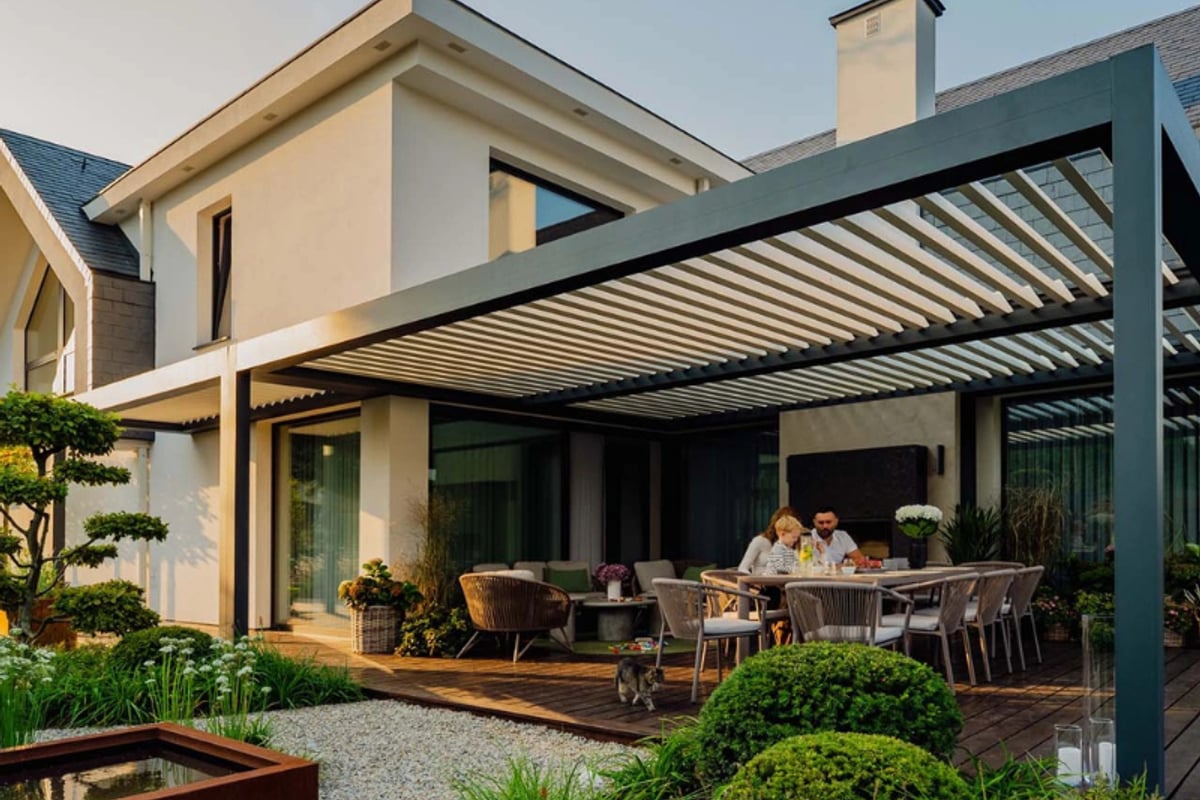
Embedded LED lighting transforms louvre roof pergola structures from daytime shade providers into evening entertainment focal points. Perimeter track lighting along blade supports creates ambient wash illumination, whilst targeted spotlights highlight cooking work surfaces and dining zones.
Modern systems integrate RGB colour-changing capabilities with individual zone control, allowing adjustment from bright task lighting during food preparation to warm, intimate settings for evening dining. Power consumption remains minimal-a typical 5m × 4m installation requires 150-200W maximum load across all lighting circuits.
Professional louvre roof pergola installation requires adherence to building regulations and industry testing standards. The California Building Code's rooftop structure requirements provide insight into wind load calculations, structural attachment specifications, and fire-resistance considerations that inform international best practice.
UK installations typically require Building Regulations approval when structures exceed 30 square metres floor area or are positioned within 1 metre of a boundary. Planning permission requirements vary by local authority, with conservation areas and listed buildings generally requiring formal applications regardless of structure size.
Understanding how louvre systems undergo performance verification helps homeowners specify appropriately tested products. International standards including AS 4740:2025 and AMCA 500-L-23 establish protocols for evaluating water penetration resistance, wind-driven rain performance, and aerodynamic characteristics across varying blade angles.
Premium manufacturers provide third-party test certification demonstrating compliance with these protocols. Key test parameters include:
British weather patterns present unique challenges and opportunities for louvre roof pergola deployment. Average UK rainfall ranges from 800mm annually in eastern regions to 1,400mm in western areas, with precipitation events concentrated during autumn and winter months.
Seasonal optimisation strategies include:
UK wind speeds vary significantly by region and exposure. Coastal Cotswold properties at 200-300m elevation may experience basic wind speeds of 22-24 m/s, whilst sheltered valley locations see 18-20 m/s. Proper structural engineering accounts for these variations alongside topographic amplification factors.
Louvre roof pergola designs must accommodate both uplift (suction) and downward pressure depending on blade position and wind direction. Closed blades create continuous surfaces experiencing maximum wind loads, whilst open configurations reduce effective surface area but increase complexity of aerodynamic calculations.
Premium louvre roof pergola systems demand minimal ongoing maintenance when properly specified. Quarterly inspections should verify blade movement remains smooth and unobstructed, with annual deep cleaning removing accumulated pollen, leaf debris, and atmospheric pollutants that may accumulate in track assemblies.
Motor assemblies typically require servicing at 5-7 year intervals, involving lubrication of drive mechanisms, verification of limit switch calibration, and replacement of weatherproofing seals. Quality systems from established manufacturers provide 10-year warranties on structural components and 5-year coverage on motorisation elements.
Properly maintained louvre roof pergola installations deliver 25-30 years of service life before requiring significant component replacement. Powder coating finishes show minimal degradation over this period when specified correctly for exposure conditions. Aluminium extrusions remain structurally sound indefinitely, with corrosion limited to surface-level pitting in severe coastal environments.
Technology updates represent the primary obsolescence factor. Control systems installed in 2016 may lack smartphone integration or weather sensor capabilities standard by 2026, creating opportunities for retrofit upgrades that extend the functional life of the structural installation.
Louvre roof pergola installations represent significant capital investments, with premium systems ranging from £15,000-£45,000 depending on size, specification, and integration complexity. For properties featuring covered outdoor kitchens, this investment transforms occasional-use amenities into daily-living extensions that fundamentally alter how homeowners interact with their properties.
Property value enhancement studies suggest well-integrated outdoor living spaces return 60-80% of installation costs upon sale, with particularly strong performance in premium property segments where outdoor entertaining capabilities align with buyer expectations. Backyard pergola installations that demonstrate architectural quality and functional sophistication command the strongest premiums.
| Investment Component | Budget Range | Mid-Range | Premium Specification |
|---|---|---|---|
| Structure (per m²) | £250-350 | £400-550 | £600-800 |
| Motorisation system | £2,500-3,500 | £4,000-5,500 | £6,500-9,000 |
| Control integration | £500-800 | £1,200-2,000 | £3,000-5,000 |
| Installation/groundworks | £3,000-5,000 | £5,500-8,000 | £9,000-15,000 |
Beyond initial capital outlay, louvre roof pergola systems incur minimal ongoing costs. Annual maintenance averages £150-£250 for professional inspection and cleaning. Energy consumption for motorisation remains negligible-typical systems consume 8-15 kWh annually for normal operation patterns.
The primary economic benefit emerges from extended outdoor living season duration. Properties in southern England typically achieve 180-200 comfortable outdoor days annually without weather protection. A louvre roof pergola installation extends this to 250-280 days, effectively doubling the return on outdoor kitchen investment through enhanced utilisation.
Modern louvre roof pergola systems offer extensive personalisation opportunities beyond basic functional requirements. Powder coating technology provides virtually unlimited colour matching, enabling precise coordination with existing architectural palettes or creation of deliberate contrast statements.
Blade profile selection influences both aesthetic character and performance characteristics. Flat-profile blades create minimalist contemporary aesthetics with efficient water shedding. Curved or aerodynamic profiles add visual interest whilst optimising airflow patterns. Perforated blade options-featuring 15-25% open area-allow partial light transmission when closed, creating dappled shade effects similar to traditional timber pergolas.
Column and beam detailing significantly impacts overall architectural character. Slender profiles (100-150mm square) create delicate, refined expressions appropriate for contemporary properties. Substantial sections (200-250mm) deliver robust, grounded presence suited to traditional architecture or exposed rural settings.
Gutter integration offers concealed or expressed options. Concealed systems hide all drainage within structural members, maintaining clean lines and minimising visual complexity. Expressed gutters acknowledge functional requirements whilst creating shadow lines and depth that enhance three-dimensional architectural quality.
The louvre roof pergola market continues evolving rapidly, with emerging technologies offering enhanced functionality and integration capabilities. Photovoltaic integration research, including studies on hybrid PV-integrated shading devices, suggests future iterations may generate electricity whilst providing climate control, offsetting outdoor kitchen energy consumption.
Automated control systems increasingly incorporate artificial intelligence and machine learning algorithms that optimise blade positioning based on historical weather patterns, current conditions, and predictive forecasting. These systems learn household usage patterns, automatically preparing spaces for anticipated entertaining events or closing protectively during extended absences.
Emerging technology trends include:
Selecting systems with modular control architectures ensures future upgrade compatibility without requiring complete replacement of structural investment.
A louvre roof pergola transforms outdoor kitchens from seasonal amenities into year-round luxury destinations, delivering precise climate control whilst maintaining architectural refinement. For discerning homeowners seeking to maximise their outdoor living investment, professional design integration ensures seamless coordination between structure, cooking equipment, and landscape context. The team at Cotswold Cooking Company brings decades of experience specifying and installing premium outdoor living solutions across the Cotswolds and beyond, offering consultative guidance from initial concept through installation and commissioning. Whether you're planning a comprehensive outdoor kitchen project or enhancing an existing space, expert advice ensures your louvre roof pergola delivers enduring performance and timeless aesthetic quality.

Leave a comment